
Stocktakes Online — Barcode Datalink
On the scanner

Scan the bin. Scan the part. Say how many.

That is the whole job, and it takes about four seconds. Everything else on this page exists so that the number which comes back is one you can act on — and so that an operator who makes a mistake can fix their own without asking anyone.

Entering a count

Two ways to be asked how many.

Which one an operator gets is a property of the person, not the device — because it is a fact about their hands. It is set when their account is created and they can change it themselves on the scanner.

KEYPAD

One form: bin, part, count

All three on screen together, filled in order and saved. The shape of every batch terminal since the eighties, and it survives because you can see what you are about to save before you save it. This is the one for a device with real keys — an MC3400 or MC9400, where a number is typed without looking down.
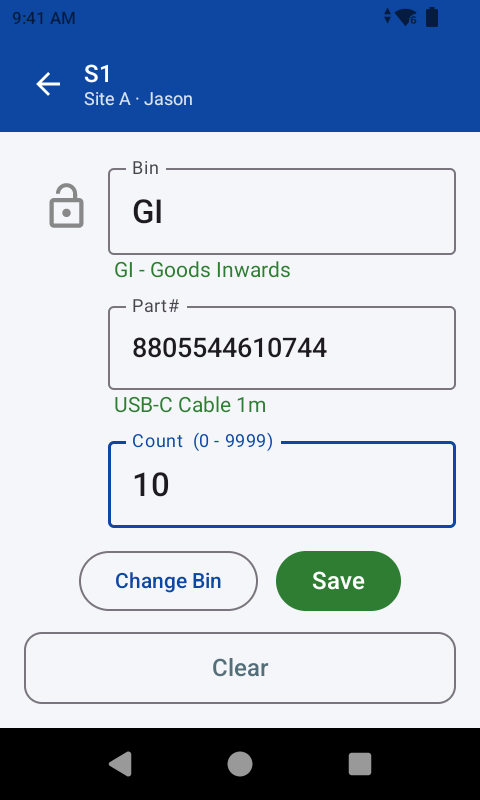
The keypad form: bin, part and count on one screen, with the part named back and a count of 10 typed
BUTTONS

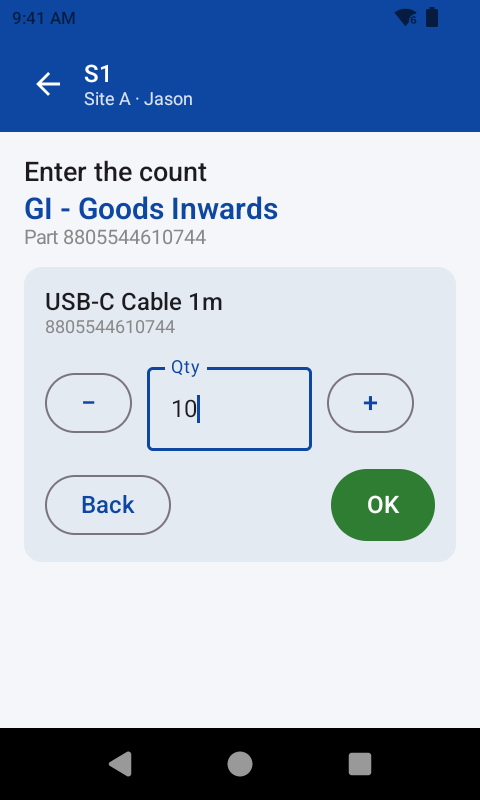
Three steps, with a keypad on screen

Scan the bin, scan the part, then a count screen with minus, plus and a starting one. Made for a touchscreen with no physical keys — a TC22, or a phone — where tapping a large button beats hunting for a digit.

The buttons count screen: bin GI named Goods Inwards, the part named back as USB-C Cable 1m, and a quantity of 10 between large minus and plus buttons
Scan/Increment

A rail of forty identical garments is forty pulls of the trigger.

Typing a count is the slow part when everything in front of you is the same thing. Scan/Increment removes the count step entirely: hold the bin, turn it on, and every scan records one more of whatever you just scanned. The running total for that part in that bin sits on screen while you work.

01

Every scan is its own record of one

Four scans of the same garment are four records of one, not one record of four. That is deliberate: a mis-scan is then a single row to delete rather than a total to work backwards from, and each pull of the trigger stays visible as the separate event it was.

02

A typed number still works

When there are plainly twelve of something, type twelve. It sets the count on the item just scanned rather than adding a thirteenth. The part is looked up first, so a part number that happens to be a plausible quantity still scans as a part.

03

It only exists inside a held bin

You lock the bin you are working, and Scan/Increment appears. Let the bin go and the mode goes with it, because counting one per scan into a bin you have walked away from is not something anyone means to do.

04

It does not ask "add or replace?"

Everywhere else, counting the same part twice in one bin raises a question. Here it does not — someone working along a rail is answering "how many are here" one item at a time, and a dialog on every garment would defeat the point.

The awkward cases

Real warehouses are not tidy.

01

A bin with nothing in it

Part number 0 marks the bin as checked and empty. That is a different fact from never having been visited, and both appear in the reports. The portal refuses it if the bin already holds counts — "this bin is empty" is a claim about the whole bin, so it has to be true for everybody, and a device only ever sees its own operator's work.

02

The same part, twice in one bin

A bin can be big enough that a part sits in two places ten metres apart, and each pile is counted where it is found. So a repeat is not silently treated as a correction: the scanner asks whether to add a second count or replace the first. Nothing collapses two counts into one without being asked.

03

Two people in one bay

Both counts stand. That is a discrepancy worth seeing rather than something to merge quietly, and the reports show who counted what, on which scanner, at what minute.

Fixing a mistake

Your counts, and only your counts.

An operator can see what they have counted, change a quantity, or withdraw a count entirely — without finding a supervisor, and without touching anybody else's work.

01

Read back from the portal

The list is not remembered on the device, it is fetched — so it survives backing out to the menu, a flat battery, and yesterday. The most recent counts, newest first, with the total beside them.

02

Only the quantity is editable

Which bin and which part came from scanning them. A count moved somewhere else by typing is not a correction, it is a different count — so the scanner will not do it.

03

Deleting withdraws, it does not erase

The count leaves every total and the row stays, so an administrator can still see that a figure was made and taken back. Nothing disappears without trace, which is the difference between correcting a mistake and hiding one.

Deliberately impossible

What the scanner will not let anyone do.

A short list, and every item on it is a decision rather than an omission.

Start or close a stocktake

An administrator does that on the portal. A count that may have been running a week does not get ended by somebody pressing the wrong thing in an aisle.

See or touch another operator's counts

Asking for somebody else's count gets the same answer as asking for one that does not exist. A device learns nothing about other people's work.

Import, export, or clear anything

There is no administration area on the device. No data to load, none to email, none to wipe.

Record an implausible quantity

Each company sets the smallest and largest count its operators may key. One extra keystroke turning 40 into 400 is refused as it is scanned, not found in a variance report three days later.

The reason all of it works

The scanner stores nothing.

Every lookup and every count is a live call to the portal. There is no local database, no queue and no overnight upload — so a count that did not arrive is reported to the operator on the spot, while they are still standing in front of the rack, rather than discovered at five o'clock when the device is docked and the shift has gone home.

It is also why an operator can pick up a different scanner tomorrow and carry on: nothing they have done lives on the one they used today.

Want to see it against your own data?

Send us a parts file and a bin location list and we will load them into a demonstration you can scan against.

Talk to us